Beyond the Product: How to Create Real Value in Discovery
Here's what I see happening in most discovery calls: reps show up with a mental checklist. Budget? Check. Timeline? Check. Decision maker? Check. They're qualifying, sure—but they're not creating value. And in mid-market B2B, if you're not creating value in discovery, you've already lost the deal to someone who is.
The best discovery calls I've witnessed don't feel like interrogations. They feel like strategic conversations where the prospect walks away thinking differently about their business. That's the shift we're making today—from product-focused qualification to value-creating consultation.
In my experience coaching hundreds of sales professionals, the reps who master this approach don't just close more deals. They close bigger deals, at higher margins, with shorter sales cycles. Because when you create real value in discovery, you're not competing on product features anymore. You're operating in a completely different category.
Why Most Discovery Calls Fail (And What Top Performers Do Instead)
The fundamental mistake I see repeatedly: treating discovery as a qualification checklist instead of a strategic conversation. Reps ask surface-level questions, fill out their CRM fields, and wonder why they can't differentiate themselves from competitors.
Here's what 'consultative selling' actually means in mid-market B2B—you're solving business problems, not filling product gaps. Your prospect doesn't wake up thinking about your product category. They wake up thinking about revenue targets, operational inefficiencies, competitive threats, and career advancement. Your product is just a potential means to those ends.
:::tip Shift your opening question from 'What do you need?' to 'What are you trying to accomplish?' This distinction changes everything. The first question gets you a shopping list. The second gets you a strategic conversation. :::
Top performers understand this instinctively. They come to discovery calls with curiosity about the business, not just the buying process. They ask about market dynamics, competitive positioning, and organizational goals. And critically—they share insights that help prospects think differently about their challenges. That's where real value creation begins.
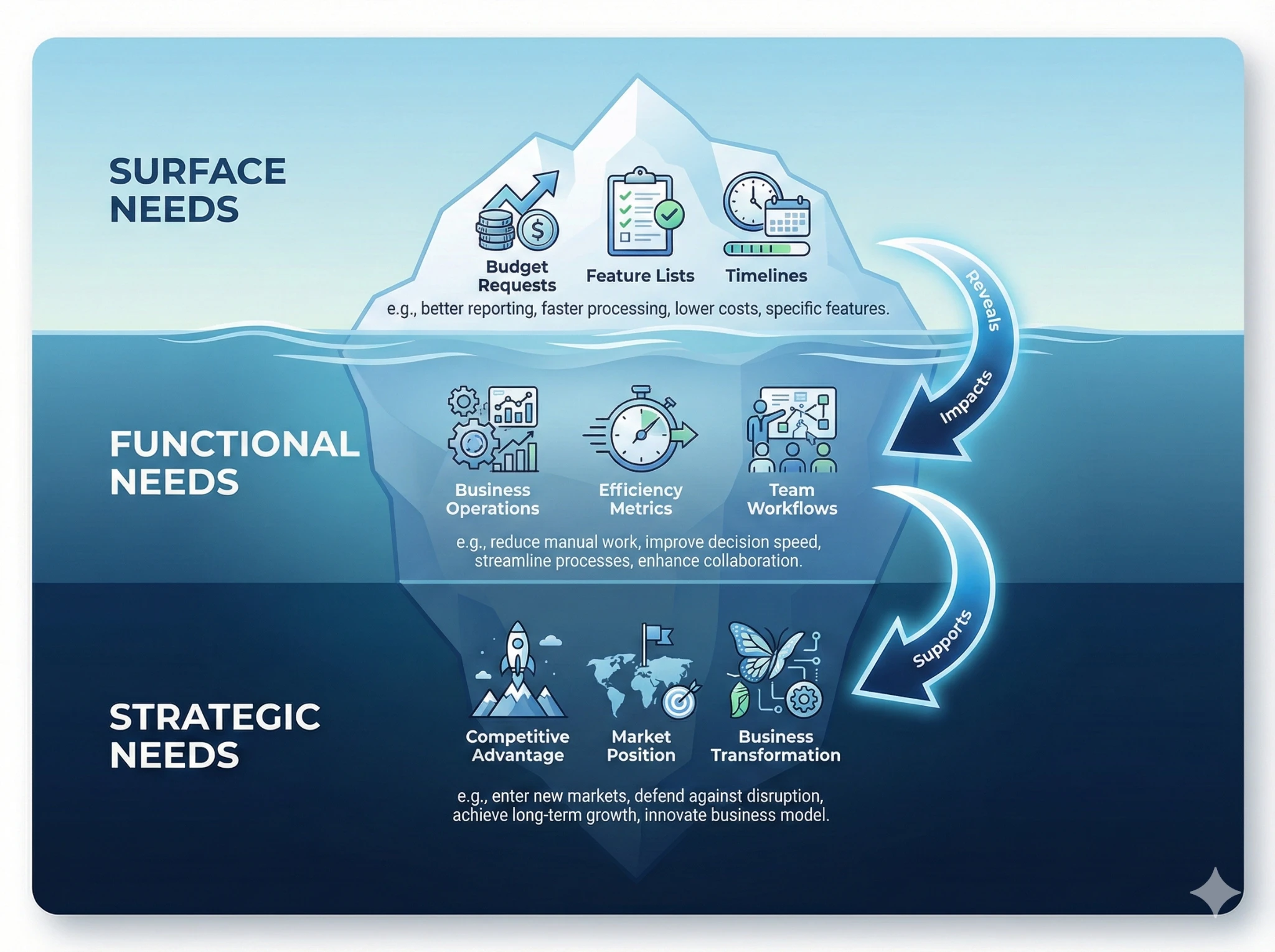
The Three Layers of Customer Needs (And Why You're Probably Only Seeing One)
Most salespeople only see surface needs—what prospects say they want. The budget request. The feature list. The timeline. This is the easiest layer to access, but it's also the least valuable for building differentiation.
Dig one layer deeper and you'll find functional needs—what the business actually requires to operate better. Maybe they said they need 'better reporting,' but functionally, they need to reduce the time their team spends on manual data compilation by 60%. Maybe they said they want 'integration capabilities,' but functionally, they need to eliminate the errors that happen when data moves between systems. This layer is where ROI conversations live.
:::keytakeaway Strategic needs—what success looks like for their career, their team, their company's future—this is where real value lives and where trusted advisors operate. :::
But here's what separates good discovery from great discovery: uncovering strategic needs. The CFO isn't just trying to reduce costs—she's trying to position the company for acquisition. The operations director isn't just trying to improve efficiency—he's trying to prove he deserves the VP promotion. The CEO isn't just trying to hit quarterly targets—she's trying to demonstrate to the board that her strategic vision is working.
Here's the challenge: customers often can't articulate their real needs at this strategic level. They might not fully understand them themselves, or they might not trust you enough yet to share them. Your job is to help them discover these needs together through thoughtful questions and genuine curiosity. When you do this successfully, you're not just uncovering needs—you're creating clarity that didn't exist before. That's value creation.
The Discovery Framework: Questions That Uncover Strategic Value
Let me share the framework I teach that consistently uncovers strategic value. Start with business context questions that reveal the bigger picture beyond your product category. 'What's changing in your market that's forcing you to rethink how you operate?' 'Where are your competitors gaining ground, and where are you pulling ahead?' These questions position you as someone who understands business, not just products.
Next, map stakeholders through conversation—who wins, who loses, who has power in this decision. Don't just ask 'Who else is involved?' Ask 'Who's going to be most impacted by this change?' and 'Who has the most to gain if this works?' and critically, 'Who might prefer the status quo?' This reveals the political landscape you'll need to navigate.
:::tip Use impact questions that quantify both pain and opportunity in business terms: 'What's this problem costing you—not just in dollars, but in team morale, customer satisfaction, competitive position?' and 'If you solve this, what becomes possible that isn't possible today?' :::
Then deploy vision questions that connect your solution to their desired future state. 'Imagine it's a year from now and this implementation has exceeded your expectations. What's different? What are you able to do that you can't do today?' This isn't just about painting a picture—it's about helping them articulate success in their own words.
Finally, use the 'teaching moment' technique—where you share insights that reframe their thinking. 'Here's an interesting pattern I'm seeing across companies in your industry...' or 'Based on what you've shared, have you considered how this connects to [adjacent challenge]?' When you teach during discovery, you demonstrate expertise and create value independent of whether they buy. That's how you build trust that transcends the transaction.
Creating Value Beyond Your Product: The Trusted Advisor Playbook
Here's where good salespeople become great ones—by creating value that has nothing to do with your product. Share industry insights and competitive intelligence they can't get elsewhere. If you're talking to multiple companies in their space, you have a unique vantage point on trends, challenges, and emerging solutions. That perspective is valuable.
Connect them to resources, people, and opportunities in your network. I've seen deals won because a rep introduced a prospect to a non-competitive vendor who solved an adjacent problem. Or shared a benchmark study that helped them make a case to their board. Or connected them with another customer who had navigated a similar challenge.
:::note The long game in consultative selling means positioning yourself as a resource even when you're not actively selling. This requires genuine generosity and a belief that creating value ultimately creates opportunities. :::
Offer strategic frameworks that help them think differently about their challenges. Maybe it's a simple diagnostic tool, a prioritization matrix, or a way of calculating hidden costs they hadn't considered. These frameworks become mental models they'll use long after your conversation ends.
Real example from my experience: A rep I coached was working a complex mid-market deal that had stalled. Instead of pushing for the close, he sent the prospect a detailed competitive analysis of their market—something his company's research team had produced. He didn't pitch his product in that email. He just shared value. Two weeks later, the prospect called him to restart the conversation. Why? Because he'd proven he was invested in their success, not just his commission. That's the trusted advisor playbook in action.
Navigating Multiple Stakeholders: Making Everyone a Winner
In mid-market B2B, you're never selling to just one person. Finance cares about ROI and budget impact. Operations cares about implementation complexity and team adoption. Executives care about strategic outcomes and competitive advantage. If you're having the same value conversation with all of them, you're doing it wrong.
The art of the multi-threaded sale is having different value conversations with different buyers while maintaining a consistent narrative. With the CFO, you're quantifying financial impact and de-risking the investment. With the ops director, you're mapping implementation timelines and addressing change management. With the CEO, you're connecting your solution to their strategic vision and board commitments.
:::warning The danger of over-indexing on one stakeholder—even if they're your champion—is that you miss the concerns of others who can kill the deal. Balance competing priorities by understanding what success looks like for each person. :::
Build internal champions by helping them look good to their bosses. Give them the data, the talking points, and the business case they need to sell internally. Your champion isn't just someone who likes your product—they're someone who can articulate the value to their organization better than you can. Invest in making them successful.
In my experience, deals stall most often not because of your product's shortcomings, but because you haven't created enough value for enough stakeholders. When you master the art of making everyone a winner, you transform from vendor to strategic partner. And strategic partners don't compete on price.
Conclusion
Here's what I want you to remember: discovery isn't about gathering information—it's about creating value. When you shift from interrogating prospects to understanding their business, from qualifying opportunities to uncovering strategic needs, from pitching products to teaching insights, everything changes.
The best discovery calls leave prospects thinking differently about their challenges and seeing possibilities they hadn't considered. They walk away with frameworks, insights, and connections that are valuable whether they buy from you or not. That's how you build trust. That's how you differentiate. That's how you become the trusted advisor instead of just another vendor.
Start with one change: in your next discovery call, ask yourself 'What value am I creating in this conversation beyond potentially selling my product?' If you can't answer that question, you're not doing consultative selling yet. But now you know how.